 Orbiont
How to achieve your goals
Most goals fail before they begin, because they were never clear enough to finish. This is a simple method that works, with a free goal builder in step one.
- A vague goal can never be achieved. A defined goal says exactly what and by when.
- Split the goal into small parts so you finish something every week and every month.
- Use only the right, necessary steps, in the right order.
- Every goal has a cost. Be sure you want it before you start.
Why most goals fail
Most people do not fail because they lack willpower. They fail because the goal was never clear enough to finish. "Get fit", "make more money" and "be happier" cannot be completed, so you can never tell if you are succeeding.
A goal needs an end line. Until you can say exactly what done looks like, you are only wishing.
| Vague wish | Defined goal |
|---|---|
| Get rich | Earn 3,000 a month from my own work by 1 September |
| Get fit | Run 5 km without stopping by 31 March |
| Learn Spanish | Hold a 10-minute conversation in Spanish by June |
| Write a book | Finish a 40,000-word first draft by 30 November |
Step 1: define the goal
Write the goal as one sentence that has three things: what exactly, how you will measure it, and by when. If you cannot measure it, it is not defined yet.
Goal builder: turn a vague wish into a defined goal
Fill in the boxes and your goal is written for you. Nothing you type leaves this page.
Every extra goal splits your attention. Most people do best with one main goal and at most two supporting ones.
Step 2: split it into smaller parts
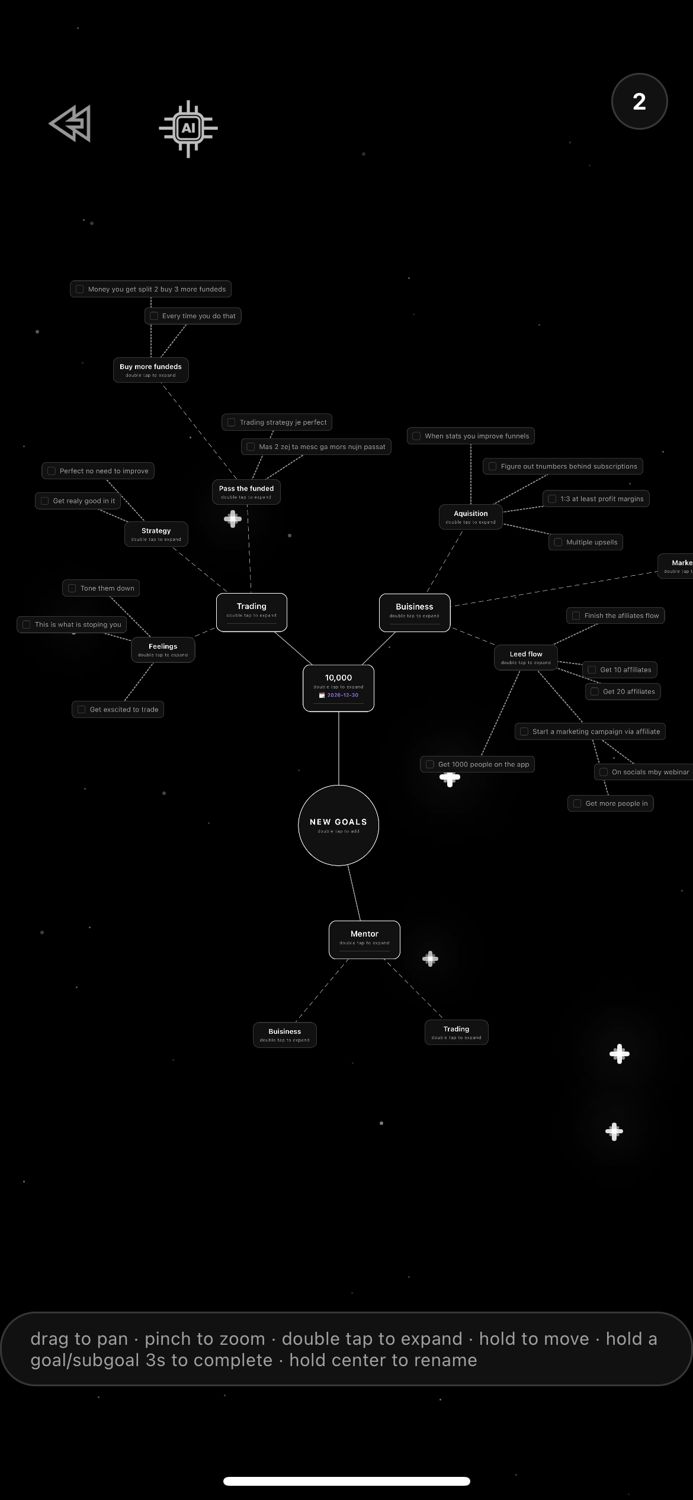
A defined goal is much easier to split. Work backwards from the end line.
- Start with the finished goal and its date.
- Break it into big chunks, such as one per month.
- Break each month into weekly parts.
- Break each week into the concrete tasks for this week.
The result is that you achieve something every week and every month. That is how you find out whether you are on track and how fast you are going. Small finished parts are feedback, and feedback is what keeps you moving.
Step 3: choose the right, necessary steps
Not every step is useful. Look at the goal and ask which steps are truly necessary to reach it. Do those, in the right order, and drop the ones that only feel productive.
Test every step with three questions
- Would the goal still be reachable without this step? If yes, it may not be necessary.
- Does something else have to happen first? If yes, put it in order.
- Can I finish it this week? If not, split it again.
Step 4: get feedback every week and month
| When | Ask yourself | If behind |
|---|---|---|
| Weekly | Did I finish this week’s part? | Shrink next week’s steps or find the blocker |
| Monthly | Am I on pace for my date? | Adjust the date or the plan, not the goal itself |
| At the halfway point | Is this still what I want? | Decide on purpose: continue, change or stop |
Falling behind is information, not failure. The mistake is to quietly give up. Change the plan out loud instead.
Step 5: make sure you really want it
Every goal has a cost, and you will have to sacrifice something to reach it. Time, comfort, money or people. Before you commit, be honest about what you would give up and whether it is worth it.
I wanted success, and I lost friends. It is always a trade.From the person who built Orbiont
That does not mean you should not chase big goals. It means you should choose them with open eyes, and protect what matters most to you while you do.
Common mistakes
- Setting goals you do not really want. You will quit at the first hard week.
- Too many goals at once. Focus beats ambition spread thin.
- No dates. A goal without a date is a wish.
- Never reviewing. A goal you do not look at drifts.
- Planning but never starting. Do the first small step today.
Your goal-setting checklist
From wish to plan in eight steps
Tick these off as you go. Your progress is saved on this device.
Questions people ask
How long does it take to achieve a goal?
It depends on the goal, so work backwards. Estimate the work, add a buffer, set a date, and then check pace every month. If you are behind, adjust the plan instead of dropping the goal.
How many goals should I have at once?
One main goal and at most two supporting ones works best for most people. More than that and you finish none.
What if I fall behind?
Do a quick review: what blocked you, and what is the smallest next step? Shrink the next week or move the date. Do not quietly give up.
What is the difference between a goal and a habit?
A goal is something you finish by a date. A habit is something you repeat. Good plans use habits to reach goals.
How do I stay motivated?
Motivation follows progress. Split the goal into small finished parts and track them. Seeing weekly progress is a stronger fuel than hype.
Can I do this in Orbiont?
Yes. The goal map is built for it: put the goal in the middle, split it into sub-goals and steps with dates, and track progress.
Plan your goal on the Orbiont goal map
Put your goal in the middle, split it into steps with dates and see your progress. On the web and on your phone.
Try Orbiont Studio free